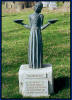
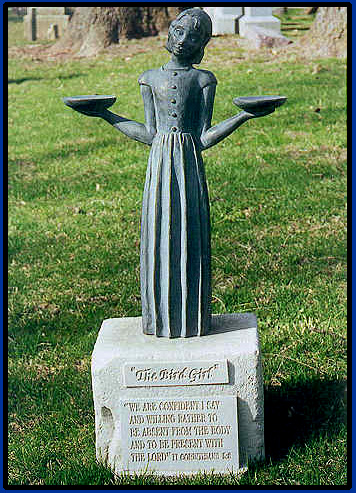
This is the famous statue featured on the cover of the book Midnight in the Garden of Good and Evil.
It was originally located in the historic Bonaventure Cemetary, but now resides in the Telfair Museum of Art.
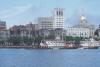
This is a photograph taken from across the Savannah River on Hutchinson Island. Riverstreet, which stretches along the river front, is paved with ballast stones from ships (not cobblestones, as some may say) and is lined with shops.
The Savannah city hall building is only one of two buildings in the nation with a gold gilded crown that is not located in a capital city. This is because Savannah was once the capital of Georgia. The other building is located in Philadelphia, as that city was once our nation's capital.
The tall white building in the center is currently a part of the First Union Bank. At fifteen floors high, it is the tallest building in Savannah.
Notice the two old timey Riverboats docked out front. These paddle-wheel boats host tours and dinners.
Savannah is always teaming with touring girl scout troops, who have made pilgrimmages from all over the country to their founder's place of birth.
The home of Juliette Gordon Low is now a museum and meeting hall for girl scouts.
Thin Mint, anyone??
If you visit Savannah, you may notice the number of things named "Oglethorpe Something." That's because General James Oglethorpe founded Savannah in 1733, to be a military buffer between the wealthy Carolina colonies and raiding parties from Spanish Florida.
Oglethorpe sold his idea to the English king by offering to take people from debtor's prison to start the new colony, thereby helping to clear the crowded English jails as well as giving prisoners a way to work off their debts.
When Oglethorpe chartered the new colony, he made four prohibitions:
No Alcohol, No Slaves, No Catholics, and No Lawyers!
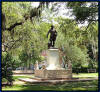
Oglethorpe's design for the city included 24 squares (21 of which still remain) to act as meeting places for the colonists in case of attack. Today the squares are shady parks, veiled with Spanish moss swaying from Live Oak trees. This one (Chippewa Square) is home to a monument in honor of General James Oglethorpe.
I bet he never thought that there would one day be a huge shopping mall named for him!
SCAD is an acronym for "Savannah College of Art and Design." It is a private art college founded in the 1970's that quickly grew to become one of the most prestigous schools of art in the nation.
The SCAD campus is Savannah. The college has bought and renovated many historic homes and buildings across town to be used for their class halls, often saving them from ruin.
You'll see many portfolio-toting students treking through the parks from hall to hall.
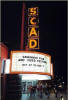
SCAD also bought this theatre located on Broughton Street, renaming it the Trustees Theatre. In addition to live performances and underground cinema, many of the students' works in film, fine art, and fashion are exhibited here.
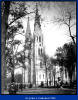
This cathedral is located downtown off Liberty Street. It was built in the 1800's during the time when the Gothic style of the 1300's was receiving a strong revival.
Architects during the Gothic period sought elements to express "more height and more light." Every angle, including the pointed archways over doors and windows, as well as the sheer height of the buildings, were to imitate the act of reaching upwards towards Heaven. An abundance of windows, including the large round and ornate window over the main entrance, known as a Rose Window, were included so as to flood the interior with "the Light of God."
The inside of the cathedral is immaculate. It has high ceilings and is decorated in murals and stained glass motifs. A grand pipe organ is built into the wall behind the altar.
St. John's Cathedral recently underwent a multi-million dollar restoration program. It is always open for touring, except during prayer services on Sunday.
The annual Savannah Jazz Festival is quickly becoming one of the most notable music festivals on the jazz scene. Typically held in late September, the festival has delighted thousands in Savannah for more than 20 years. Coordinated by the Coastal Jazz Association, this 4-day festival brings some of the best jazz musicians, both well-known and unknown, to the city.
First celebrated here in 1813, the present-day St. Patrick’s celebration can last up to four days and includes a spectacular parade, a round of parties and concerts and a humongous street party. This is our version of New Orleans' Mardi Gras!
Coincidentally, Savannah and New Orleans are the only two cities in the nation which legally allow alcoholic beverages, in plastic to-go cups, to be taken out of bars and restaurants and into the streets.
This celebration is held around or on March 17th each year and is located downtown on Riverstreet and City Market.
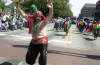
Pictured here are the Alee Temple guys, doing their best bellydancer impersonations, at a previous St. Patrick's Day parade.
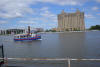
Pat took this picture of the Savannah River from colonial Riverstreet. The new Weston Hotel and Trade Center are visible on Hutchinson Island.
Recently the small island separating Savannah from South Carolina underwent a major development project. The revenue generated from the new golf course and race track, along with the hotel and huge trade center, was to be spent on fixing the drainage and flooding problem in Savannah.
Unfortunately, the golf course and trade center receive few patrons, the race track went bankrupt after the first event, and the hotel foreclosed and was auctioned on the courthouse steps.
But that colorful boat sure is neat!
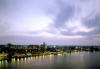
This is Riverstreet adorned with the pinks and blues of Sunset. Enchanting.